
Physical and financial drift
The model can retain an old area, unit count or delivery program after the scheme changes.
Keep site quantities, costs, revenue, financing, timing and risk connected so every viable scenario can be tested as its own investment case.
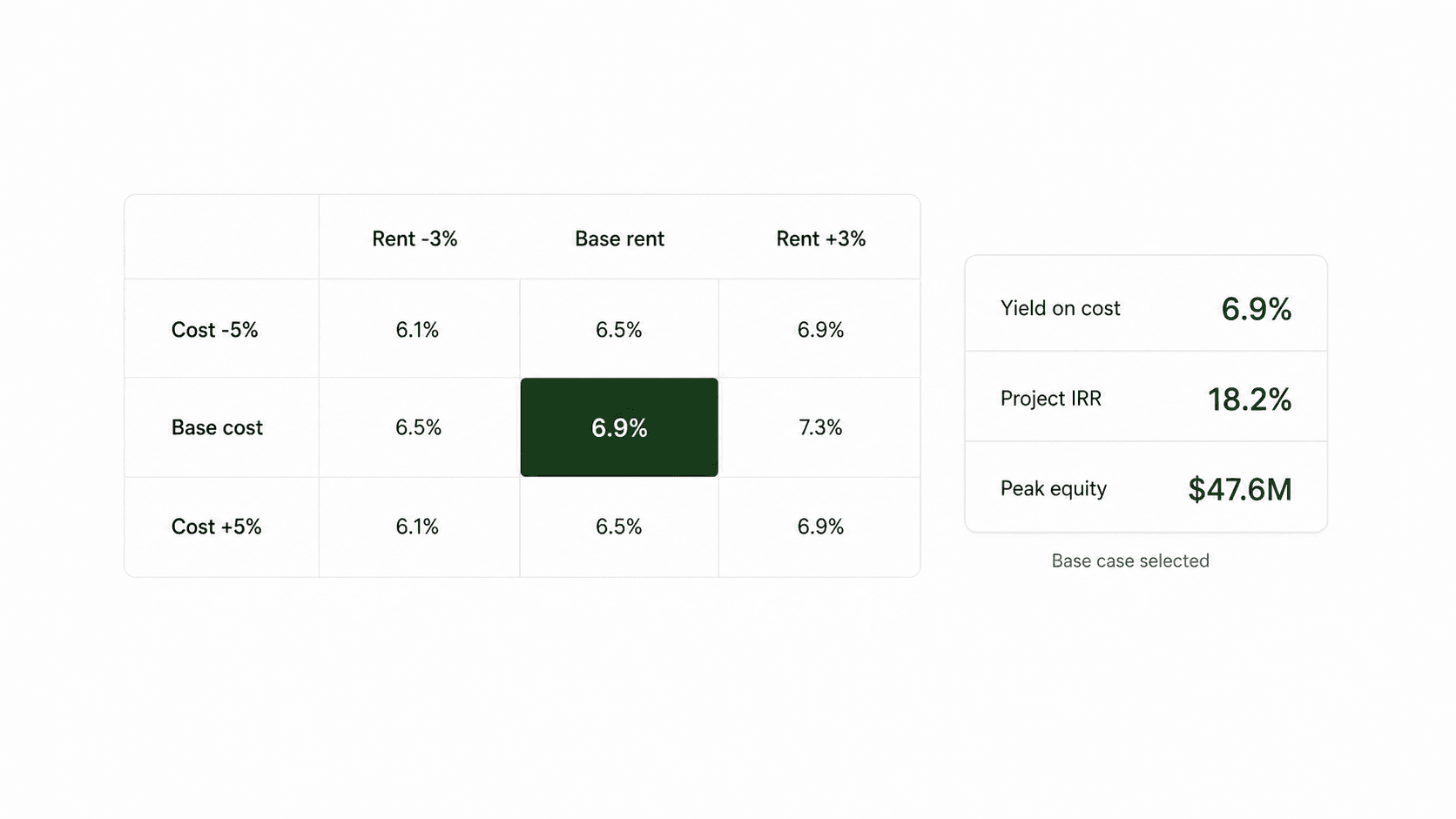
Developer questionDoes the preferred scheme meet our return threshold—and which assumptions could change that answer?
Teams copy quantities and timing between design files and financial models, then spend review cycles finding which version contains the current development case.
The model can retain an old area, unit count or delivery program after the scheme changes.
Land, cost, rent, delay and financing risks are tested in separate files or not at all.
A headline IRR can obscure peak equity, timing, downside exposure and the assumptions driving it.
The model remains connected to the physical program and the evidence supporting its assumptions.
Bring area, units, parking, infrastructure and phasing directly from the selected scenario.
Apply acquisition, cost, revenue, financing, timing and exit assumptions.
Calculate cost timing, debt and equity draws, revenue, stabilization and exit.
Test land price, cost, lease-up, delay, financing and exit sensitivities.
The preferred scenario is evaluated against the organization’s thresholds and the few assumptions with the greatest decision impact.
“Does the preferred scheme meet our return threshold—and which assumptions could change that answer?”
RecommendationAdvance the base case with Scenario B as the preferred development plan.
Every result stays connected to the opportunity, the assumptions behind it and the workflow that comes next.
Keep a separate financial case for every viable physical development option.
See cost, capital, revenue and exit timing across the delivery period.
Identify the assumptions most capable of changing the recommendation.
Show where the case clears or misses the organization’s required return and risk criteria.
Put the strongest opportunities and scenarios beside the same strategy benchmark.
Yes. Acquisition, cost, financing, revenue, timing and return thresholds can reflect your organization’s model and policy.
Yes. Each viable scheme can retain its own quantities and financial case for consistent comparison.
UnlockLand supports connected scenario analysis and decision preparation; organizations can retain their required approval models and controls.
Bring a live deal, your current assumptions and the decision your team needs to make.