
Too many false positives
Acreage and asking price say little about viable capacity, approval risk or land basis per home.
Screen the market around your acquisition strategy, build a comparable first-pass development case for every viable site and focus the team on the opportunities that deserve time.
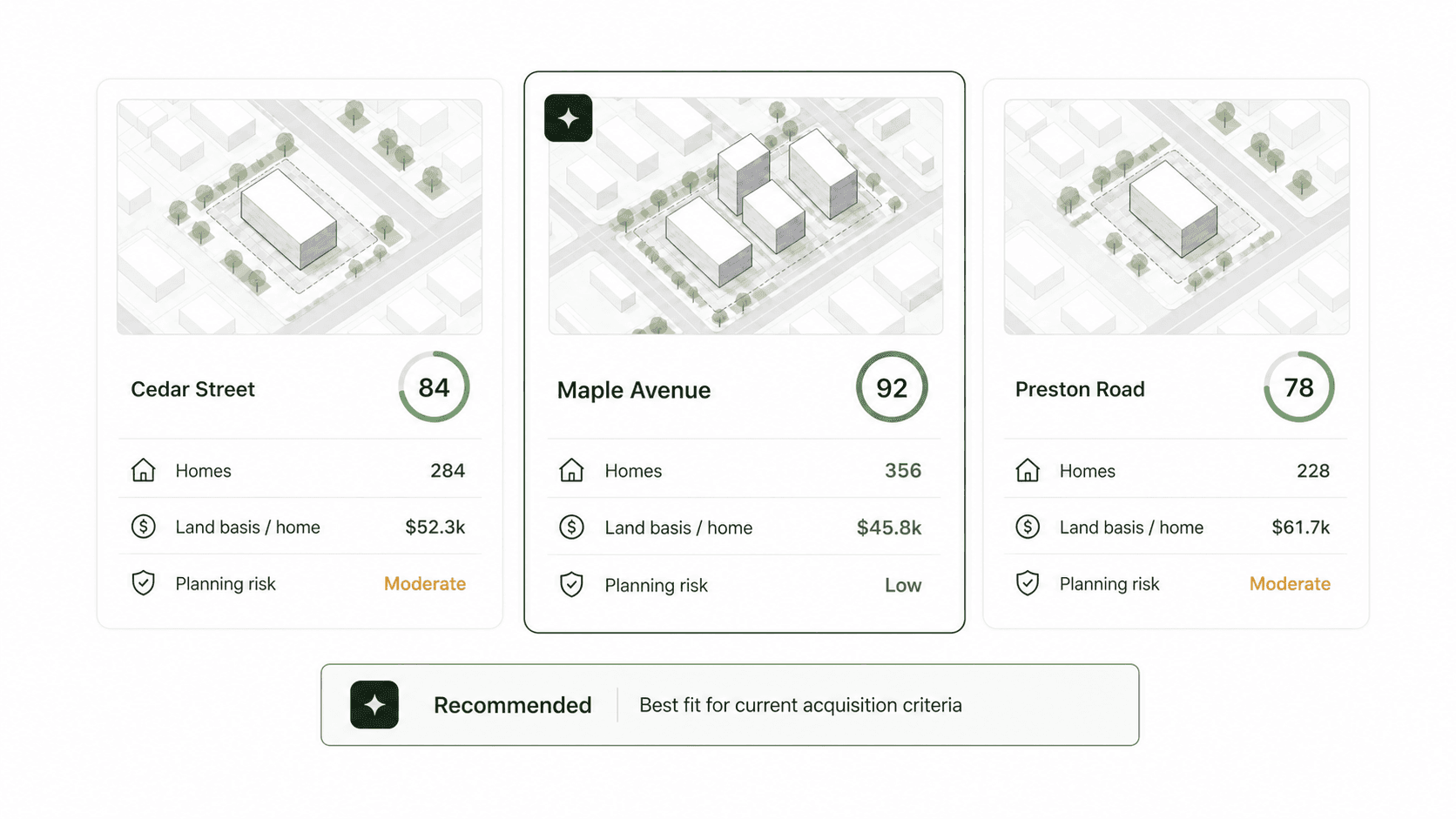
Developer questionWhich available sites can actually support our strategy—and which should we pursue first?
Teams still spend senior time opening listings, requesting drawings and rebuilding the same first-pass questions before they know whether a site fits the mandate.
Acreage and asking price say little about viable capacity, approval risk or land basis per home.
Different team members use different assumptions, formats and levels of diligence.
Awkward or overlooked parcels are rejected before their development potential is tested.
UnlockLand evaluates sites as potential developments before your team commits to deeper pursuit.
Set geography, asset type, scale, land basis, return threshold and planning tolerance.
Collect the market inventory and qualify parcel, ownership and listing information.
Test capacity, planning pathway, program fit, preliminary economics and key risks.
Show which opportunities clear the strategy and why they rise above the alternatives.
The recommendation combines program fit, land efficiency, planning confidence and preliminary return—not a single score without context.
“Which available sites can actually support our strategy—and which should we pursue first?”
RecommendationAdvance Maple Avenue into structured feasibility and scenario testing.
Every result stays connected to the opportunity, the assumptions behind it and the workflow that comes next.
See available, qualified and recommended sites in geographic context.
Open every shortlisted site with the same development and economic fields.
Understand what moved an opportunity above or below the strategy threshold.
Carry the selected sites into Compare, Test-Fit and Feasibility without rebuilding the case.
Put the shortlisted opportunities beside one another before deeper work begins.
No. It gives your team a consistent development screen across broker listings, direct opportunities and other available-land sources.
Yes. Geography, program, land basis, return, timing and risk thresholds can reflect your organization’s mandate.
No. Market and planning evidence can be combined with your assumptions, private opportunity data and later professional review.
Bring a live deal, your current assumptions and the decision your team needs to make.