
Too few options
One concept cannot show the trade-off between yield, efficiency, planning pathway and delivery risk.
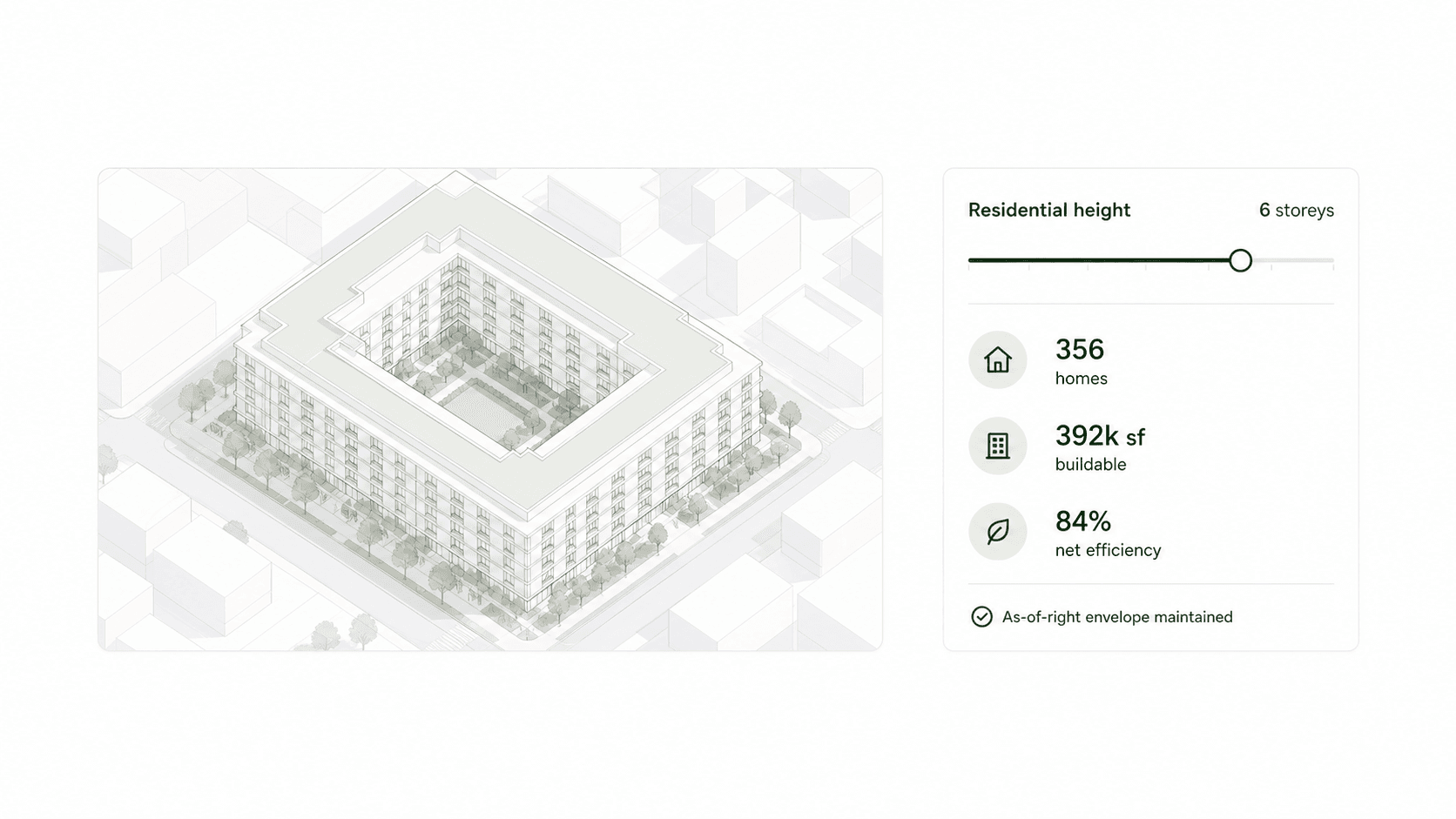
Turn site constraints and program targets into configurable development scenarios, then see how capacity, unit mix, efficiency and planning compliance change together.
Developer questionWhat are the credible ways to develop this site—and which scheme best supports the development strategy?
Development teams often wait for a single concept, then optimize around it before seeing whether a different program or planning path would produce a stronger case.
One concept cannot show the trade-off between yield, efficiency, planning pathway and delivery risk.
A different unit mix or setback can trigger new drawings, quantities and financial updates.
Physical changes are not consistently reflected in cost, revenue and comparison metrics.
Each scenario retains its physical program, compliance basis, quantities and decision assumptions.
Apply parcel geometry, access, setbacks, height, density, parking and open-space rules.
Set target use, unit mix, amenity, efficiency, parking and phasing requirements.
Create as-of-right, optimized, alternate-program and rezoning-upside cases.
Review capacity, compliance, efficiency, cost, return and risk across the options.
The highest unit count does not automatically become the preferred scenario. Efficiency, planning certainty and economic resilience remain visible.
“What are the credible ways to develop this site—and which scheme best supports the development strategy?”
RecommendationAdvance Scenario B as the preferred scheme for feasibility and underwriting.
Every result stays connected to the opportunity, the assumptions behind it and the workflow that comes next.
Keep the credible alternatives rather than replacing each drawing with the next.
Track area, unit mix, capacity, parking and efficiency for each scheme.
Show which controls pass, which require interpretation and which need approval.
Carry scenario quantities into cost, revenue, underwriting and comparison.
Validate the planning, infrastructure and delivery basis behind the preferred scheme.
No. It helps teams explore and compare early development options before detailed architectural work begins.
Yes. As-of-right and discretionary scenarios can be kept separate so the upside and approval dependency remain visible.
Connected quantities can flow into scenario-level cost, revenue and return assumptions for comparison.
Bring a live deal, your current assumptions and the decision your team needs to make.