
Deliver more homes without creating an incomplete community.
Public development
Turn public land into a community that works.
What is the best long-term future for this land—and can we actually deliver it?
UnlockLand helps governments, public land organizations and strategic master developers align policy, land, infrastructure and delivery before committing to a community plan.
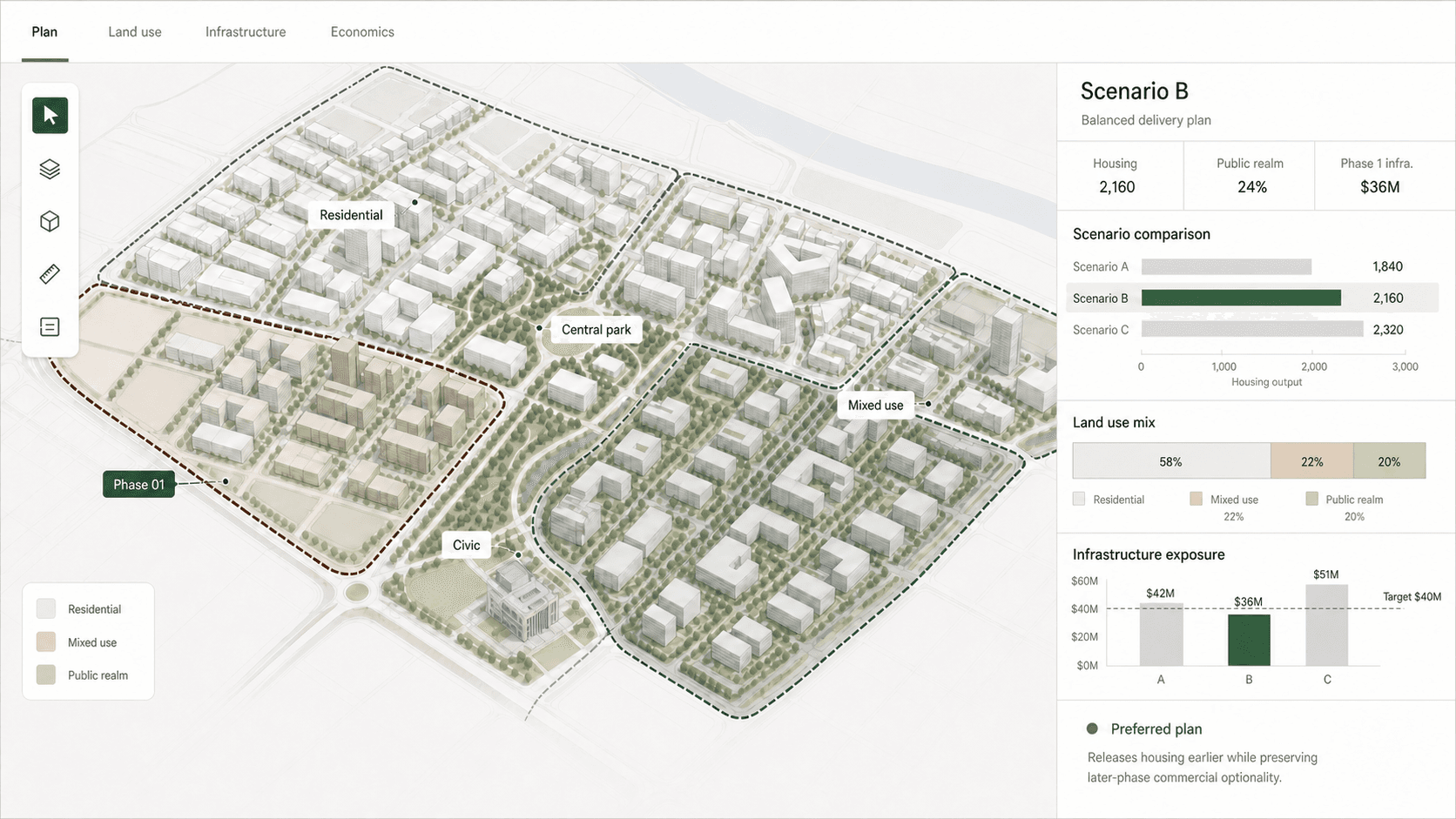
Plan a Live CommunityEast Harbour CommunityScenario B · Preferred
The public development challenge
A community is not a single project.
It is a long-term promise made across housing, infrastructure, public services, economic growth and place. Those obligations compete for the same land, capital and time.
Sequence transit, utilities, roads and public facilities with growth.
Protect affordability, livability, climate and long-term land value.
Keep agencies, advisers and delivery partners working from one plan.
Public development fails when the housing plan, infrastructure plan and delivery plan are treated as separate decisions.
Why decisions become difficult
One community. Many mandates. No shared version of the future.
Policy sits in strategies. Land data sits in GIS. Consultants model separate workstreams. Infrastructure constraints arrive late. Leadership receives a presentation after the assumptions have already diverged.
Needs an earlier first phase
Density depends on funding
$38M enabling works
Land must be reserved now
Value capture assumptions open
Sequence under negotiation
One community decision system
Connect the public mandate to a deliverable program.
UnlockLand keeps the “why,” the plan, the dependencies, the professional judgment and the final approval connected as the community evolves.
- 01Public mandate→
Housing, economic, climate and community outcomes
- 02Land & evidence→
Parcels, policy, constraints, studies and existing commitments
- 03Community scenarios→
Land use, density, facilities, public realm and phasing
- 04Infrastructure plan→
Capacity, cost, dependencies, triggers and delivery owners
- 05Joint review→
Planning, housing, finance, infrastructure and professional assurance
- 06Approved program
A defensible decision, conditions and a coordinated path to delivery
Community outcome model
Evaluate the whole community—not isolated outputs.
Every scenario brings the physical plan, public outcomes, infrastructure exposure and delivery timing into one reviewable model.
- Test housing and affordability together
- Reserve land for future public services
- See capital triggers before approving density
- Retain the assumptions behind every outcome
Preferred community futureBalanced, transit-led growth
Scenario BInfrastructure before promises
A housing target is only credible when the infrastructure arrives.
Connect every development phase to utilities, mobility, schools, parks, funding and responsible delivery organizations before the preferred plan is approved.
202720292031203320352037
Housing · Phase 1Delivery
Housing Authority
Trunk water + sewerEnabling
Utility Agency
Transit stationCritical
Transit Authority
Primary schoolTrigger · 1,800 homes
Education Agency
Central park + civic hubPublic realm
Master Developer
Housing · Phases 2–4Dependent
Delivery Partners
Cross-organization coordination
Each team keeps its mandate. Everyone works from the same community.
No new department has to own every answer. UnlockLand gives each group the view it needs while preserving one set of scenarios, assumptions, comments and decisions.
Is the plan delivering the city’s housing, growth and climate mandate?
Which parcels move first, and what must be protected for later phases?
Can density, public realm, facilities and built form work together?
What capacity is required, when is it triggered and who delivers it?
What does each future cost, fund and expose the organization to?
Why is this future preferred, what remains unresolved and what is being approved?
Compare complete futures
Make the trade-offs visible before choosing the plan.
Compare the community each scenario creates—not only unit count, density or financial return.
Community outcomeScenario AHousing firstMaximum near-term supply Scenario B · PreferredComplete communityBalanced long-term outcome Scenario CEmployment-ledMaximum economic land
New homes5,8004,8502,900
Affordable homes1,1601,450580
Jobs1,2002,1006,400
Public infrastructure$246M$214M$278M
Community facilities463
Transit dependencyPhase 2Phase 1Immediate
Delivery riskMedium–highMediumHigh
Long-term flexibilityMediumHighMedium
An accountable decision
Show how the preferred future was chosen.
Leadership should see the mandate, alternatives, evidence, infrastructure implications, professional comments and unresolved conditions—not just the final rendering.
Professional assuranceIndependent planning, design, cost and delivery judgment enters at the decisions that matter.
Executive decision recordEast Harbour Community · Gate 03
Ready for decisionMandateHousing + transit-led growthAlternatives3 complete futures comparedPreferred futureBalanced communityProfessional reviewPlanning · Design · CostOpen conditions3 before program approvalRecommendationAdvance to delivery planning
Built for public land stewards
For organizations responsible for a place—not only a project.
Public Development supports organizations that must balance public purpose, commercial reality and long-term delivery across changing teams and decision cycles.
01National, state and municipal governments02Public land and housing authorities03Urban redevelopment and transit agencies04Government-backed master developers05International strategic and city developers06Economic development and special-zone authorities07University, healthcare and innovation districts08Defence, infrastructure and public estate organizations
Public Development FAQ
Designed for complex, accountable development.
01Can we evaluate a complete new community, not only individual sites?+
Yes. UnlockLand connects land use, housing, employment, public realm, infrastructure, facilities, phasing and delivery assumptions within complete community scenarios.
02Can each department use its own outcome criteria?+
Yes. Planning, housing, infrastructure, finance, land and leadership can review the same scenario through the outcomes relevant to their mandate while retaining one shared decision record.
03Can we include non-financial public value?+
Yes. Housing delivery, affordability, climate, accessibility, community facilities, economic impact, public realm and other organization-specific outcomes can sit alongside capital and delivery measures.
04How does infrastructure planning connect to development scenarios?+
Every scenario can retain service capacity, cost, timing, dependencies, delivery owners and trigger points so growth promises remain connected to a credible infrastructure program.
05Can we use our existing GIS, policy, consultant and financial material?+
Yes. Existing parcels, reports, models, plans, policy documents and third-party studies can be brought into the opportunity record rather than rebuilt from scratch.
06Can external advisers and delivery partners participate?+
Yes. Internal teams, appointed consultants, professional reviewers and development partners can contribute within controlled stages while the organization retains the authoritative record.
07Can we compare delivery strategies as well as physical plans?+
Yes. Compare land release, infrastructure sequencing, funding exposure, partnership structure, phasing and risk—not only density or land-use diagrams.
08What reaches leadership or an executive committee?+
A concise recommendation with the mandate, alternatives, public outcomes, infrastructure implications, professional comments, open conditions, evidence and decision rationale.
Public development
Plan a Live Community Plan the community. Prove the decision. Coordinate the delivery.
Bring a live public land or strategic community program into UnlockLand.